
Managing a UAE apartment building means balancing tenant satisfaction with operational costs. Laundry is one of the most complained-about shared facilities machines that are always busy, always breaking down, or simply not available when residents need them.
The solution most building managers in Dubai, Sharjah, and Abu Dhabi are switching to is a dedicated shared laundry room equipped with a commercial coin operated washing machine. For UAE apartment buildings specifically, this setup removes laundry as a daily complaint, generates passive income through coin collections, and runs with minimal staff involvement.
Done right, it pays for itself within months. Done wrong with the wrong machine specification or the wrong supplier it becomes a maintenance headache that costs more than it earns.
This guide is written specifically for building managers and property owners. By the end, you’ll know exactly what capacity to install, how to price cycles, what ROI to expect, and what questions to ask before signing anything with a supplier.
Why a Coin Operated Washing Machine in UAE Apartment Buildings Makes Business Sense
Dubai’s resident population reached 4.74 million in mid-2026, growing at 7.5% annually and a large portion of that population lives in high-density apartment blocks without in-unit washing machines. Areas like Deira, Bur Dubai, Al Qusais, International City, Al Nahda, and Discovery Gardens house thousands of residents in buildings where laundry facilities are a shared amenity, not a given.
For building managers, this creates both a problem and an opportunity:
The problem: Unmanaged laundry rooms with free or poorly monitored machines lead to overuse, abuse, high maintenance costs, and constant resident complaints about availability.
The opportunity: A properly installed coin operated washing machine setup in a UAE apartment building turns that shared facility into a self-funding, low-maintenance service that pays for itself within months and generates consistent revenue long after.
The UAE’s laundry appliances market is projected to grow from USD 371 million in 2025 to USD 489 million by 2030. Coin-operated laundry is a significant and growing part of that driven directly by urbanisation and the growth of shared accommodation.
Who Is This Guide For?
This guide is for:
- Building managers responsible for shared laundry facilities in residential towers
- Property developers planning laundry infrastructure in new apartment blocks
- Facility managers in staff accommodation, hostels, and mixed-use buildings
- Investors evaluating whether a coin laundry setup makes financial sense for their property
If you’re a resident looking for a machine to use this guide is written for the people who install them.
What Is a Coin Operated Washing Machine?
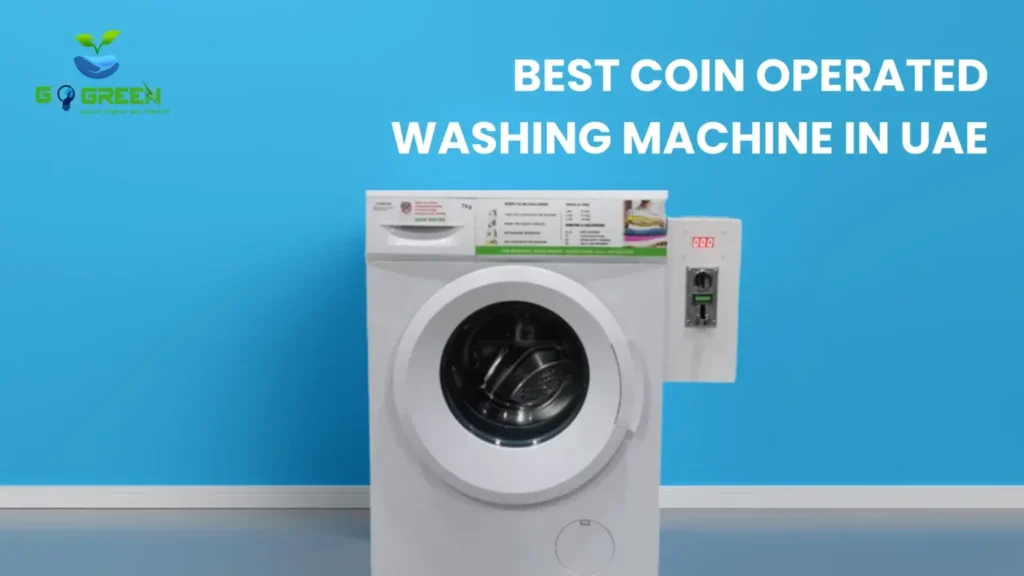
A coin operated washing machine is a commercial-grade washer that activates only after the user inserts coins, tokens, or in modern units makes a card or mobile payment. Once activated, the machine runs a complete wash cycle with no staff input needed.
These are not household machines with a coin slot attached. Commercial coin-op units are built with industrial-grade components designed for continuous daily use: heavy-duty stainless-steel drums, reinforced door seals, high-torque motors, and tamper-resistant coin collection systems.
In a typical UAE apartment building, a shared laundry room might process 20–40 loads per day. A domestic machine would fail under that load within a year. A properly rated commercial unit is built to handle it for 10–15 years with scheduled maintenance.
How Many Machines Does Your Building Need?
This is the first question to answer before anything else and most suppliers won’t give you a straight answer because it depends on your building.
A general rule used across UAE shared facilities:
- 1 washing machine per 15–25 residents for standard shared laundry rooms
- 1 washing machine per 10–15 residents for high-occupancy buildings or labor-intensive environments
So for a 100-unit apartment building where most residents don’t have in-unit laundry:
- Minimum: 4 machines
- Recommended: 6 machines to avoid peak-hour queuing
Undershooting machine count is the most common mistake building managers make. Queues during evening peak hours (6pm–9pm) generate complaints fast. Always size for peak demand, not daily average.
Pair each washer with a matching coin operated dryer Dubai’s indoor humidity makes air-drying after a wash cycle impractical, and a dryer adds a second revenue stream per laundry visit.
Choosing the Right Capacity
Machine capacity should match your expected load size, not just resident count.
| Building Type | Recommended Capacity | Why |
|---|---|---|
| Studio/1BR apartments (solo residents) | 7–10 kg | Smaller individual loads |
| 2–3BR apartments (families) | 10–14 kg | Larger family loads including bedding |
| Staff accommodation / hostels | 12–18 kg | High daily volume, bulk loads |
| Mixed residential tower | 10–14 kg | Covers most load types |
Avoid going too large a 20 kg machine running half-empty wastes water and electricity with every cycle. Equally, machines under 7 kg create bottlenecks when residents bring full loads of clothing or bedding.
Front Load vs Top Load: Which Is Right for UAE Apartment Buildings?
For UAE apartment buildings, front-load machines are the right choice in almost every case.
| Factor | Front Load | Top Load |
|---|---|---|
| Water per cycle | 40–60 litres | 80–100 litres |
| Electricity consumption | Lower | Higher |
| Spin speed | Up to 1,200 RPM | 700–800 RPM |
| Laundry dryness after spin | Drier — less dryer time needed | Wetter — longer drying |
| Cleaning performance | Superior | Good for light loads |
| Durability under heavy use | Higher | Lower |
| Upfront cost | Higher | Lower |
The water saving alone makes front-load the right call in Dubai. DEWA tariffs are tiered high-consumption buildings pay more per unit. A front-load machine using 50 litres per cycle vs a top-load using 90 litres saves 40 litres per wash. Across 30 cycles per day and 365 days, that’s over 438,000 litres annually a meaningful utility saving at scale.
Understanding Cycle Costs and ROI
Here is a realistic worked example for a medium-sized apartment building:
Scenario: 80-unit residential tower, 4 x 12 kg front-load coin-op machines installed
- Machine cost: AED 8,000 per unit = AED 32,000 total
- Average cycles per machine per day: 7
- Total daily cycles (4 machines): 28
- Charge per cycle: AED 8
- Daily revenue: AED 224
- Monthly revenue: AED 6,720
- Monthly utility cost (water + electricity): approximately AED 700–900
- Net monthly income: approximately AED 5,820–6,020
- Payback period: approximately 5–6 months
After payback, the machines generate net income with costs limited to scheduled maintenance (budget AED 500–800 per machine per year) and periodic descaling due to Dubai’s hard water.
Per-cycle pricing in UAE apartment buildings typically ranges from AED 5 to AED 12 depending on location and building type. Upscale residential towers in Dubai Marina or JLT can charge toward the higher end; buildings in Deira or Al Qusais typically sit at AED 5–8.
Payment Options: Coins, Cards, or Both?
The right payment system depends on your residents.
Coin-only systems are simple, reliable, and lower cost. They work well in buildings with older demographics or where most residents are comfortable with cash transactions. The drawback is coin collection management and the occasional coin jam.
Card and mobile payment systems are increasingly preferred in newer residential developments, especially those serving young professionals and expats. They eliminate coin jams, simplify revenue tracking, and appeal to residents who rarely carry cash.
Hybrid systems accept both coins and cashless payment. These are the most flexible option and future-proof your setup as cashless preference continues to grow in the UAE.
For most UAE apartment buildings being set up in 2026, a hybrid system or at minimum card-enabled machines is the recommended approach.
The Role of Coin Operated Liquid Detergent Dispensers
A coin operated liquid detergent dispenser is a natural addition to any shared laundry room and one that solves a real problem for building managers.
Without a dispenser, residents bring their own detergent. This leads to overuse, spills, residue buildup inside machines, and detergent being left in the laundry room. Over time, excess detergent in drum seals and dispensers causes mold, odour, and machine faults.
A coin-operated dispenser solves all of this. The right amount of liquid detergent is dispensed per cycle, eliminating waste and protecting the machine internals. It adds another small revenue stream per wash visit and keeps the laundry room cleaner.
GoGreen Electronics supplies dispensers matched to the coin-op machines same coin denomination, same user experience, installed as one integrated setup.
UAE-Specific Maintenance Considerations for Apartment Buildings
Dubai’s operating environment is harder on laundry machines than most suppliers will tell you upfront.
Hard water descaling: Dubai’s desalinated water supply is high in dissolved minerals. Limescale builds up on heating elements and internal components, reducing efficiency and eventually causing failure. Monthly descaling with an approved agent is non-negotiable maintenance for any coin-op machine in the UAE.
Ventilation: Laundry rooms in apartment basements or service areas with poor ventilation trap heat and humidity. This shortens motor and control board life significantly. Ensure adequate exhaust ventilation is in place before installation it’s a building infrastructure requirement, not just a comfort measure.
Coin and payment mechanism cleaning: Fine sand and dust common in Dubai infiltrate coin slots and card readers. Weekly inspection and cleaning prevents jams and lost revenue.
Filter and drain maintenance: Weekly lint filter clearing and monthly drain hose inspection prevents blockages that cause flooding and machine faults in enclosed laundry rooms.
Ask your supplier for a written maintenance schedule at installation. A supplier who doesn’t provide one is not thinking about your long-term ownership costs.
What to Ask Your Supplier Before Buying
Most building managers are not laundry equipment specialists and suppliers know this. These are the questions that protect you before signing anything:
- What is the daily cycle rating on this machine? (You need at least 8–10 cycles/day for shared apartment use)
- Do you hold spare parts in the UAE? (Overseas lead times mean long downtime)
- What is your average service response time in Dubai?
- Do you offer an Annual Maintenance Contract?
- Can you conduct a site assessment before recommending machine count and layout?
- What descaling product do you recommend for UAE hard water?
- What warranty is included and what does it cover?
A supplier who can answer all seven clearly and specifically is a supplier worth working with. Vague answers on spare parts availability or service response time are red flags.
Why Building Managers Choose GoGreen Electronics
GoGreen Electronics has supplied coin operated washing machines to apartment buildings, labor camps, hotels, and laundromats across Dubai and the UAE from its base in Al Quoz Industrial Area 4.
The difference in working with a local supplier versus an online-only vendor shows up the moment something needs servicing. GoGreen’s team operates with a UAE-held spare parts inventory, conducts site assessments before installation, and provides AMC support for predictable long-term costs.
The full setup for apartment buildings includes:
- Commercial coin operated washing machines matched to building size and daily volume
- Paired coin operated dryers to complete the laundry service
- Coin operated liquid detergent dispensers for integrated self-service setup
- Site assessment and layout planning
- Professional installation and commissioning
- Annual Maintenance Contracts
For building managers in Abu Dhabi or Northern Emirates, GoGreen also covers coin operated washing machines in Abu Dhabi with the same local service model.
Contact GoGreen Electronics to arrange a site visit and get a machine count, layout, and cost recommendation matched to your building.
Coin Operated Washing Machines for UAE Apartment Buildings
How many coin operated washing machines does a UAE apartment building need?
A basic setup with 2 washers and 2 dryers requires approximately 15–20 square metres including access space. A room as small as 10 sq metres can accommodate 2 machines if ventilation is adequate. GoGreen conducts site assessments to recommend the optimal layout for your available space.
Who is responsible for maintenance the building or the supplier?
That depends on your agreement. With GoGreen’s Annual Maintenance Contract, the supplier handles scheduled maintenance and repairs. Without an AMC, maintenance falls to the building. In either case, daily basics (coin slot cleaning, filter checks) are handled by building staff.
Can I set my own pricing per cycle?
Yes. The per-cycle charge is set by the building manager and programmed into the machine at installation. GoGreen can advise on pricing benchmarks for your area and building type.
What happens when a machine breaks down?
With GoGreen’s local service team and UAE spare parts inventory, most faults are diagnosed and repaired within 24–48 hours. This is why supplier choice matters an overseas supplier with no local presence means weeks of downtime waiting for parts.
Do coin-op machines comply with UAE building regulations?
Commercial laundry equipment supplied by GoGreen meets UAE standards. For facilities subject to specific regulatory requirements (labor camp standards, RERA compliance), GoGreen can advise on appropriate machine specifications and installation requirements.
Is the income from coin collections taxable in the UAE?
Revenue from building amenities including laundry facilities falls under general UAE corporate tax rules introduced in 2023. Consult your accountant for guidance specific to your property structure.
How do I get started?
Contact GoGreen Electronics for a site assessment. The team will visit your building, assess your laundry room space, estimate daily volume based on unit count, and recommend a machine configuration with projected ROI.